
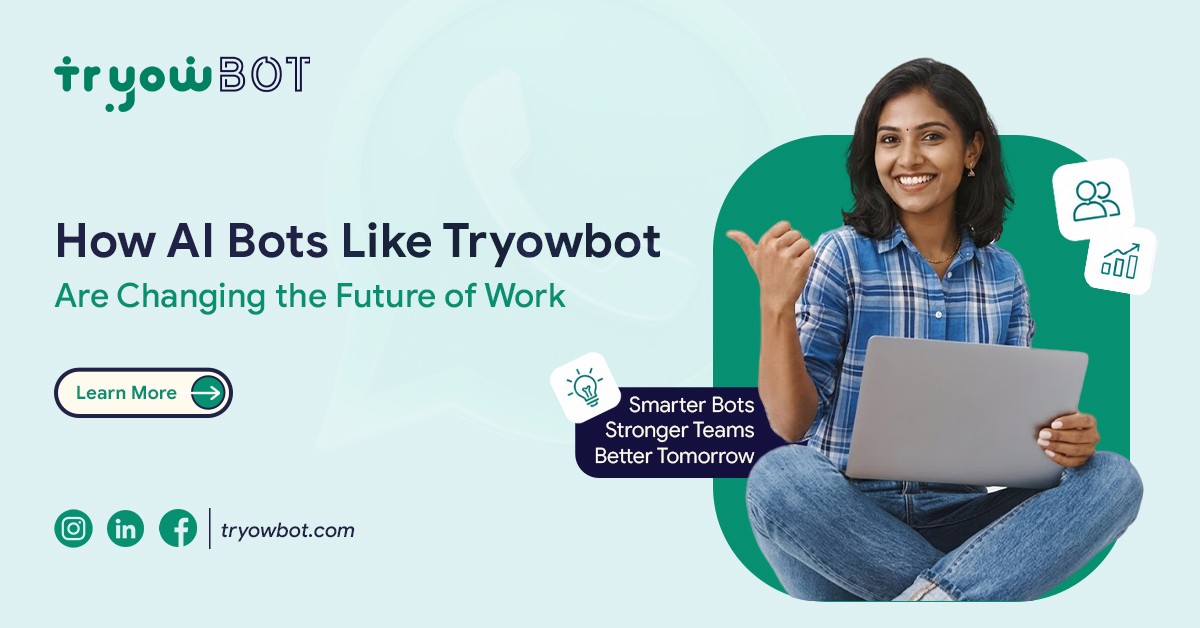
AI is not just a new tool – it’s quietly rewiring how work gets done. Platforms like TryowBOT, built around messaging – first automation and AI agents, are shifting customer communication, operations, and even company design toward smaller, faster, always – on teams. Here’s what’s changing and what it means for founders, operators, and workers.
1. Customer communication moves to where people already are
- Messaging – first engagement: Customers live in WhatsApp. AI bots meet them there with instant, contextual replies, rich media, and deep links that shorten the path from question to purchase. This shift lifts response speed, conversion, and loyalty compared to email or phone.
- End-to-end journeys inside chat: From size guides and “Buy Now” links to order confirmations, delivery updates, refunds, and NPS surveys – conversations become the new funnel. Automation handles 24/7 FAQs and routing; humans step in only for edge cases.
2. Operations compress: fewer steps, fewer handoffs
- Automating routine work: AI bots now handle onboarding sequences, reminders, support triage, and follow-ups – reducing the need for large support teams and minimizing human error. Startups scale output without scaling headcount.
3. Solo founders and small teams punch above their weight
- Agents as leverage: Reliable function – calling and structured outputs have made fully automated workflows practical at scale, enabling tiny teams to operate like much larger orgs – particularly in niche software markets.
- New business viability: When 90% of repetitive execution is automated, more micro-markets become profitable. Human time shifts to judgment, prioritization, and taste while agents drive execution.
4. The labor market picture: change is real, disruption is gradual
- Macro stability so far: Despite headlines, broad U.S. employment metrics since late 2022 don’t show a sharp AI-induced shock. Trends look more like continuity than rupture, echoing prior tech waves. It’s early – and measurement needs better usage data – but economy – wide disruption hasn’t arrived yet.
- Micro-level reconfiguration: At the firm level, roles are being redesigned. Support agents become escalation experts; marketers become orchestrators of automated journeys; operators become data-driven workflow designers.
5. What businesses can do now
- Start in the highest-friction channels: Move customer support and order updates to WhatsApp with opt-in and approved templates; measure first-response time, resolution rate, and CSAT.
- Automate proven playbooks: Abandoned carts, win-backs, back-in-stock alerts, appointment reminders, and post-purchase NPS are reliable revenue and CX lifts. Track conversion per message, unsubscribe rate, and incremental ROAS.
- Keep humans for the hard parts: Use agents for 24/7 responsiveness and task execution; reserve people for complex support, negotiation, creative strategy, and relationship-building.
- Build for measurement: Instrument engagement analytics and conversion tracking from day one, so you can attribute lift to specific automations and iterate quickly.
6. What workers can do now
- Specialize in “agent-plus” skills: Workflow design, prompt/process engineering, data interpretation, and escalation handling are rising in value.
- Focus on human differentiators: Domain expertise, synthesis, storytelling, and trust-building pair best with automated execution.
- Treat AI as an amplifier: Use bots to eliminate busywork and create space for higher-impact projects – then make those results visible.

The takeaway
AI bots like TryowBOT are moving work from manual, multi-step processes into continuous, conversational, and instrumented flows. For businesses, that means faster cycles, lower costs, and higher conversion. For workers, it means fewer repetitive tasks and a premium on human judgment and communication. The future of work won’t be no human – just more human where it matters, with AI quietly handling the rest.