Imagine your business receives 100 enquiries in a month. Some customers are ready to purchase, some are comparing prices, some are just exploring options, and others may not even need your product or service.
Should your sales team spend the same amount of time on every enquiry?
Probably not.
One of the biggest challenges businesses face is not simply generating leads. It is identifying which leads have a genuine interest in buying and deciding which opportunities deserve attention first.
When sales teams treat every enquiry equally, valuable opportunities can get delayed while time is spent following up with prospects who are not ready to purchase.
This is where lead qualification, lead scoring and sales prioritisation become important.
A well-organised CRM system helps businesses understand customer requirements, evaluate buying signals, assign leads to the right salespeople and plan follow-ups based on priority.
In this guide, we will explore how to identify high-quality leads, evaluate sales opportunities, prioritise follow-ups and use CRM software to build a more effective sales process.
What Are High-Quality Leads?
A high-quality lead is a potential customer who has a genuine requirement for your product or service and has a reasonable possibility of becoming a paying customer.
However, a lead should not be considered high-quality simply because someone submitted an enquiry form, clicked an advertisement or requested a price.
Businesses need to understand whether the prospect is a suitable customer and whether there is a realistic opportunity to make a sale.
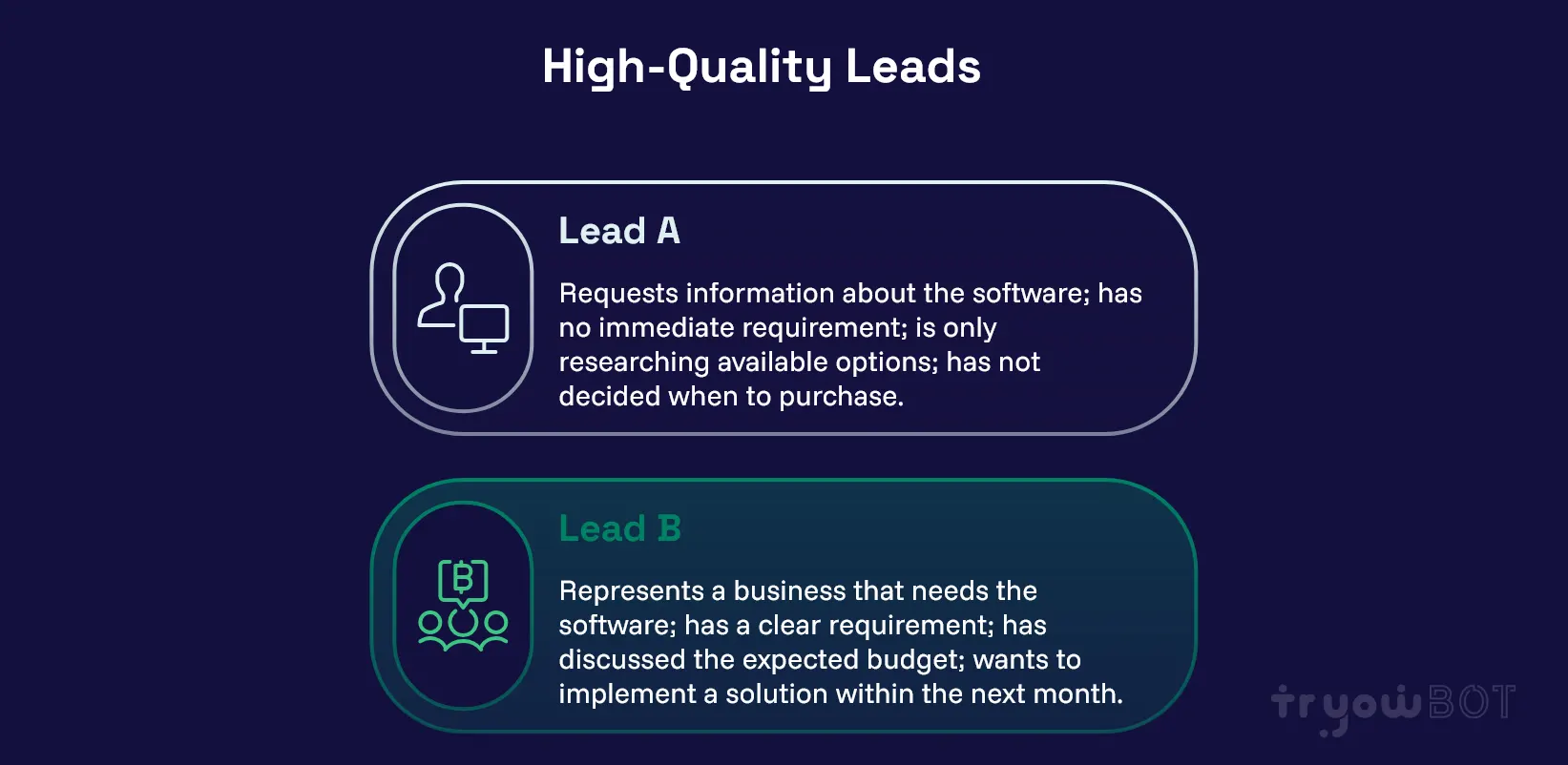
For example, consider a company selling business software.
It receives two enquiries:
Lead A
- Requests information about the software.
- Has no immediate requirement.
- Is only researching available options.
- Has not decided when to purchase.
Lead B
- Represents a business that needs the software.
- Has a clear requirement.
- Has discussed the expected budget.
- Wants to implement a solution within the next month.
Both are genuine enquiries, but Lead B currently shows stronger buying intent.
Therefore, Lead B should generally receive higher priority from the sales team.
The important point is that lead quality depends on the customer's requirements, suitability, engagement and readiness to purchase, not simply the number of enquiries received.
Why Businesses Should Not Treat Every Lead Equally
Many businesses follow the same process for every incoming enquiry: assign a salesperson, make a call and continue following up.
Although this approach may work with a small number of leads, it becomes difficult when enquiry volumes increase.
Here are five common problems caused by treating every lead equally.
1. Sales Teams Waste Time on Unqualified Enquiries
Some enquiries may not match your target customer profile.
For example, a customer may have a budget far below your minimum pricing, or their requirement may not be supported by your business.
Without qualification, sales representatives may spend considerable time pursuing opportunities that are unlikely to close.
2. High-Intent Customers Experience Delays
Imagine a customer who is ready to purchase but has to wait two days for a callback.
Meanwhile, your sales team is spending time following up with less interested prospects.
That delay could give the customer an opportunity to contact a competitor.
High-intent enquiries deserve timely attention.
3. Sales Representatives Struggle to Manage Follow-Ups
When salespeople handle many leads simultaneously, remembering every conversation, requirement and promised callback becomes difficult.
Without proper task management, important follow-ups may be delayed or forgotten.
4. Marketing and Sales Teams Misunderstand Performance
Marketing teams may report that a campaign generated 200 leads, but the sales team may find that only a small percentage were suitable prospects.
This creates a gap between lead generation and actual business results.
Businesses need to measure lead quality and sales outcomes, not only enquiry volume.
5. Managers Cannot Identify the Best Sales Opportunities
Without a clear lead management process, managers may struggle to understand:
- Which leads are ready for a sales discussion?
- Which prospects need additional information?
- Which opportunities are waiting for follow-up?
- Which leads are becoming inactive?
- Which lead sources generate successful deals?
A CRM system helps organise this information so managers can make better decisions.
How to Identify High-Quality Leads: 6 Important Factors
Lead qualification should follow a consistent process. Instead of relying only on a salesperson's personal opinion, businesses can evaluate enquiries using specific criteria.
Here are six factors to consider.
1. Customer Requirement
The first question is simple: Does the customer actually need what your business offers?
A genuine requirement is one of the strongest indicators of a potential sales opportunity.
For example:
- A company looking for an attendance management system has a relevant requirement for an HR software provider.
- A retailer searching for inventory management software may be a suitable prospect for an inventory solution.
- A business looking for automated customer communication may be a potential customer for a WhatsApp automation platform.
Your sales team should understand the customer's problem before recommending a solution.
What to check:
- What problem is the customer trying to solve?
- Does your product or service address that problem?
- Is the requirement relevant to your business?
- Is the customer looking for a solution you can realistically provide?
2. Budget and Purchasing Capacity
A customer may have a genuine requirement but may not have the budget to purchase your solution.
Discussing budget expectations helps your sales team understand whether the opportunity is commercially realistic.
For example, if your software package starts at ₹30,000 per year and the prospect expects to spend ₹5,000, the salesperson needs to understand whether there is flexibility or whether the prospect is unsuitable.
However, do not reject a customer only because their initial budget is unclear. Some customers need help understanding the value of a solution before deciding how much to invest.
What to check:
- Has the customer discussed a budget?
- Is the expected budget realistic?
- Does the customer understand the pricing?
- Is there flexibility in the purchasing budget?
3. Decision-Making Authority
Not every person who contacts your business has the authority to approve a purchase.
In B2B sales, enquiries may come from employees, executives, department heads or business owners.
For example, an employee may be researching software for their company, but the final purchasing decision may belong to the HR manager or business owner.
Understanding the decision-making process helps sales representatives identify the right people to involve.
What to check:
- Is the person responsible for the purchase?
- Who approves the final decision?
- Does the customer need approval from another department?
- Can a meeting be arranged with the decision-maker?
4. Purchase Timeline
A customer's purchase timeline helps determine how quickly the opportunity needs attention.
Consider these three prospects:
| Prospect | Purchase Timeline | Priority |
| Customer A | Ready to purchase this week | High |
| Customer B | Planning to purchase next month | Medium |
| Customer C | Researching options for next year | Long-term nurture |
All three prospects may be valuable, but they need different follow-up approaches.
A customer who wants to purchase immediately should receive more urgent attention than someone researching solutions for a future requirement.
What to check:
- When does the customer want to purchase?
- Is there an implementation deadline?
- Is the decision dependent on another event?
- Has the customer agreed to a specific next step?
5. Engagement and Buying Signals
Customer engagement provides useful information about interest and purchase intent.
For example, a prospect who responds to follow-up messages, requests a product demonstration and discusses implementation requirements may show stronger interest than someone who only submitted a form.
Useful buying signals include:
- Asking for a quotation.
- Requesting a product demonstration.
- Discussing implementation.
- Asking about payment terms.
- Sharing detailed requirements.
- Scheduling a meeting.
- Responding consistently to follow-ups.
However, engagement alone does not guarantee a sale. A customer may be highly responsive but still lack the budget or authority to purchase.
Always evaluate engagement alongside other qualification factors.
6. Customer Fit
A high-quality lead should also match the type of customer your business is designed to serve.
For example, a software company may specialise in solutions for small and medium-sized businesses. An enquiry from a large enterprise with complex custom requirements may need a different sales approach.
Customer fit helps businesses focus on prospects whose requirements, industry, company size and expectations align with their products or services.
What to check:
- Does the customer belong to your target industry?
- Is the company size suitable?
- Can your product support the customer's requirements?
- Are the customer's expectations realistic?
- Can your business provide long-term value?
What Is Lead Qualification? Understanding the BANT Framework
Lead qualification is the process of evaluating whether a potential customer is a suitable sales opportunity.
One commonly used approach is the BANT framework.
BANT stands for:
- B – Budget: Can the customer afford the solution?
- A – Authority: Are you speaking with the decision-maker?
- N – Need: Does the customer have a genuine requirement?
- T – Timeline: When does the customer plan to purchase?
Let's understand how businesses can apply this framework.
| BANT Factor | Question to Ask | What It Reveals |
| Budget | What budget have you allocated? | Purchasing capacity |
| Authority | Who will approve the purchase? | Decision-making process |
| Need | What problem are you trying to solve? | Requirement and solution fit |
| Timeline | When are you planning to implement? | Purchase readiness |
For example, a company looking for CRM software may have an immediate requirement, an approved budget and a decision-maker participating in the discussion.
This would generally be a stronger opportunity than an enquiry with no confirmed requirement or purchasing timeline.
BANT is a useful starting point, but businesses should adapt qualification criteria to their industry. Not every customer will disclose their budget or purchase timeline during the first conversation.
What Is Lead Scoring and How Does It Work?
Lead scoring is a method of evaluating potential customers using a score that represents their relative level of interest, suitability or sales readiness.
Instead of manually reviewing every lead in the same way, businesses can use lead scoring to identify which enquiries deserve closer attention.
For example, consider a company receiving enquiries from website forms, Facebook Ads, WhatsApp and referrals.
A lead scoring approach may consider:
- Customer requirement.
- Budget suitability.
- Purchase timeline.
- Engagement level.
- Response history.
- Previous interactions.
A prospect with strong buying signals may receive a higher score, while someone with limited information or low engagement may receive a lower score.
Example of a Lead Scoring Model
The following is an illustrative scoring framework that businesses can adapt to their sales process. It is not a fixed scoring formula.
| Qualification Factor | Example Scoring |
| Clear product requirement | +20 |
| Budget confirmed | +20 |
| Decision-maker identified | +15 |
| Purchase planned within 30 days | +20 |
| Requested a demo or quotation | +15 |
| Responded to follow-up | +10 |
| Maximum illustrative score | 100 |
Based on this example, a business could classify leads as follows:
| Score Range | Lead Category | Suggested Action |
| 80–100 | Hot Lead | Contact immediately and discuss the next sales step |
| 50–79 | Warm Lead | Continue qualification and schedule follow-up |
| 0–49 | Cold Lead | Nurture and gather more information |
These ranges are suggested for this example only. Businesses should adjust their scoring model based on historical conversion data.
A lead score should guide prioritisation, not replace human judgement. A low-scoring lead can still become a valuable customer, while a high-scoring prospect may eventually decide not to purchase.
How to Prioritise Sales Opportunities Effectively
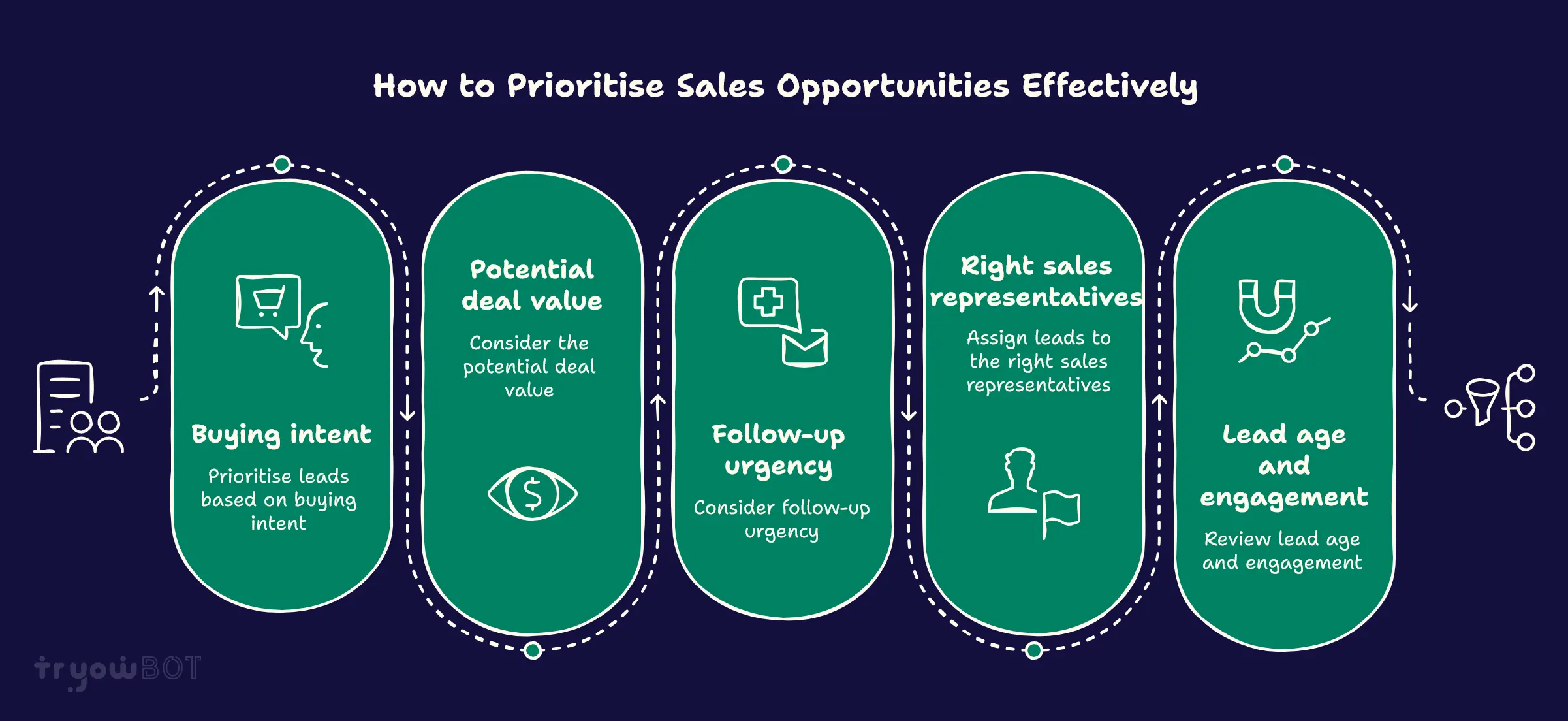
Identifying high-quality leads is only half the process. Your sales team also needs a practical system to decide what to work on first.
Here are five ways to prioritise sales opportunities.
1. Prioritise Leads Based on Buying Intent
A customer requesting a quotation or product demonstration may be closer to making a purchase than someone who is only exploring available options.
Your team should review buying signals and give immediate attention to prospects showing strong interest.
For example:
- Customer requesting a quotation: High priority.
- Customer comparing product features: Medium priority.
- Customer researching general information: Lower immediate priority.
2. Consider the Potential Deal Value
Not every opportunity contributes the same amount of revenue.
A small purchase and a large enterprise contract may require different levels of attention and resources.
However, deal value should not be the only priority factor. A large opportunity with very low purchase probability should not automatically take precedence over a smaller, ready-to-close deal.
Evaluate deal value alongside customer fit, buying intent and timeline.
3. Consider Follow-Up Urgency
An interested customer who has requested a callback today should not wait until next week.
Follow-up urgency depends on the customer's expectations, previous conversations and agreed next steps.
A practical task priority system could look like this:
| Task Priority | Suitable For | Recommended Action |
| High | Hot leads, qualified prospects, overdue commitments | Same-day action |
| Medium | Normal follow-ups, proposals and demos | Within 1–2 working days |
| Low | Long-term prospects and nurturing | Within the week |
The most important rule is to honour the follow-up time promised to the customer.
4. Assign Leads to the Right Sales Representatives
Some leads require specialised knowledge or industry experience.
For example:
- Enterprise enquiries may need senior sales representatives.
- Real estate enquiries may need a dedicated property sales team.
- Technical product enquiries may require a representative who understands the solution.
Assigning leads based on source, industry, group or sales expertise can improve ownership and follow-up consistency.
5. Review Lead Age and Engagement
A lead that was interested two months ago may no longer have the same purchase intent.
Businesses should regularly review inactive and ageing leads.
A simple approach:
- New leads: Contact and qualify quickly.
- Recently engaged leads: Continue the conversation.
- Leads with pending decisions: Schedule specific follow-ups.
- Inactive leads: Re-engage with a relevant reason.
- Unresponsive leads: Review whether further follow-up is worthwhile.
Do not assume every old lead is lost. Some prospects simply need more time before making a decision.
How CRM Software Helps Businesses Identify and Prioritise High-Quality Leads
Managing lead quality manually becomes difficult as the number of enquiries grows.
A CRM system helps businesses maintain customer information, track sales interactions and organise follow-up activities in one place.
Here are the important CRM capabilities that support lead qualification and prioritisation.
1. Centralised Lead Management
Enquiries may arrive from multiple channels, including:
- Website enquiry forms.
- Facebook and Instagram lead forms.
- WhatsApp conversations.
- Email enquiries.
- Referral partners.
- Manual sales entries.
A CRM brings these enquiries into a central system.
This helps sales teams review customer details, identify lead sources and avoid managing enquiries through disconnected spreadsheets.
2. Lead Status Tracking
A lead status shows where a prospect currently stands in the sales journey.
For example:
| Lead Status | Meaning | Next Action |
| Open / New | Enquiry received | Contact the customer |
| Engaged / Contacted | Initial interaction recorded | Understand the requirement |
| Qualified | Meets sales qualification criteria | Convert into a deal |
| Proposal / Negotiation | Commercial discussion is progressing | Follow up and address objections |
| Won | Customer purchased | Record the sales outcome |
| Lost | Opportunity ended | Record the reason |
The exact status names depend on the business's CRM configuration.
Keeping statuses updated helps managers understand the sales pipeline and identify opportunities that need attention.
3. Lead Scoring and AI-Powered Suggestions
Some CRM platforms provide lead scoring to help sales representatives identify which enquiries may deserve priority.
For example, a lead profile may display a score, a lead temperature such as Hot Lead and suggested next steps.
This helps salespeople decide whether to contact a customer, arrange a meeting or gather more information.
AI-generated suggestions should be reviewed before taking action. Their usefulness depends on the accuracy and completeness of the information recorded in the CRM.
4. Lead Segmentation
Lead segmentation allows businesses to group customers based on selected conditions.
For example, a sales manager may want to identify:
- Qualified leads from Facebook Ads.
- Uncontacted website enquiries.
- Hot leads assigned to a particular salesperson.
- Leads with follow-ups due today.
- Corporate customers with active opportunities.
- Leads that have remained open for more than two weeks.
By creating focused lead segments, sales teams can work on specific groups instead of reviewing the entire lead database repeatedly.
5. Automatic Lead Assignment
A lead should always have a clear owner.
Automatic assignment helps distribute enquiries based on predefined rules.
Common assignment approaches include:
- Source-based assignment: Send Facebook Ads leads to the advertising sales team.
- Group-based assignment: Route corporate enquiries to the corporate sales team.
- Round-robin assignment: Distribute leads among sales representatives in rotation.
- Acceptance-based assignment: Require the assigned salesperson to accept the lead.
This helps reduce delays and makes sales responsibility easier to track.
6. Follow-Up Tasks and Reminders
A high-quality lead can still be lost if the sales team does not follow up at the right time.
CRM task management helps representatives organise:
- Follow-up calls.
- Product demonstrations.
- Meetings.
- Quotation discussions.
- Customer callbacks.
- Proposal reviews.
Every active opportunity should have a responsible salesperson, a clear next action and a due date.
7. Sales Pipeline and Performance Reports
Managers need to understand whether qualified leads are actually becoming customers.
CRM reports help evaluate:
- Total leads received.
- Lead distribution by source.
- Qualified and unqualified enquiries.
- Ageing leads.
- Deals created.
- Deals won and lost.
- Revenue by source.
- Sales representative performance.
These insights help businesses identify weak lead sources, improve qualification criteria and make better decisions about sales resources.
How TryowBOT CRM Helps You Manage and Prioritise Sales Leads
Identifying high-quality leads requires more than collecting contact information. Businesses need a structured process to qualify enquiries, assign responsibility, track interactions and manage sales opportunities.
TryowBOT CRM helps businesses organise these activities through its lead management, lead scoring, segmentation, task management and reporting capabilities.
Here is how it supports the sales process.
Identify Hot Leads with Lead Score
TryowBOT CRM includes a Lead Score feature that displays a percentage-based score, a lead temperature label such as Hot Lead and suggested next steps.
Sales representatives can review the score and suggestions from the lead profile to decide which opportunity to work on first.
The score should be treated as guidance rather than a guaranteed prediction of purchase.
Qualify Leads Before Converting Them into Deals
Sales teams can update lead statuses as customers progress through the sales journey.
Once a prospect meets the business's qualification criteria, the representative can convert the lead into a deal.
Deal records can include the deal date, amount, notes, owner and outcome.
This helps distinguish a general enquiry from a qualified sales opportunity.
Segment Leads Using Filters
TryowBOT CRM supports lead filtering using conditions such as source, group, status, assigned user and follow-up date.
For example, managers can identify qualified Facebook and Instagram Ads leads or find uncontacted enquiries that need immediate attention.
This helps teams focus on the right group of leads.
Assign Leads to the Right Salesperson
Businesses can manage lead ownership through manual assignment, bulk assignment, automatic assignment rules and round-robin distribution.
Leads can also be assigned based on source or group, helping businesses route enquiries to the appropriate sales team.
Organise Follow-Ups with Tasks and Calendar
TryowBOT CRM provides task management and calendar features to organise customer follow-ups, meetings, demonstrations and other sales activities.
Tasks can be assigned priorities, due dates and owners.
The AI-assisted follow-up task feature can also draft a suggested next task based on the remarks entered when completing an activity. The salesperson can review and edit the suggestion before saving it.
Monitor Lead Quality and Sales Performance
The CRM dashboard and reports help managers review lead sources, lead ageing, sales activity, deals won and revenue.
This makes it easier to understand which enquiries are progressing and where improvements are needed.
With TryowBOT CRM, businesses can move beyond simply collecting enquiries and build a more organised process for identifying, managing and converting sales opportunities.
ExploreTryowBOT CRM to learn how structured lead management can support your sales process.
Common Lead Qualification Mistakes Businesses Should Avoid
Even businesses with an established sales team can make mistakes when evaluating and prioritising leads.
Here are some common problems to watch out for.
| Mistake | Why It Is a Problem | Better Approach |
| Judging quality by enquiry volume | More leads do not always mean more customers | Measure qualified leads and conversions |
| Ignoring customer requirements | The solution may not fit the prospect | Understand the actual business problem |
| Treating every lead as urgent | Sales resources become poorly distributed | Prioritise by intent, fit and timeline |
| Ignoring follow-up dates | Interested customers may lose confidence | Create tasks with clear due dates |
| Depending only on lead scores | Scores may not reflect every detail | Combine scores with sales judgement |
| Leaving lead statuses outdated | Managers cannot see the real pipeline | Update statuses after meaningful interactions |
| Not recording lost reasons | Businesses repeat the same sales mistakes | Record why opportunities were lost |
| Assigning leads without ownership checks | Enquiries may remain unattended | Review assignment and pending acceptance |
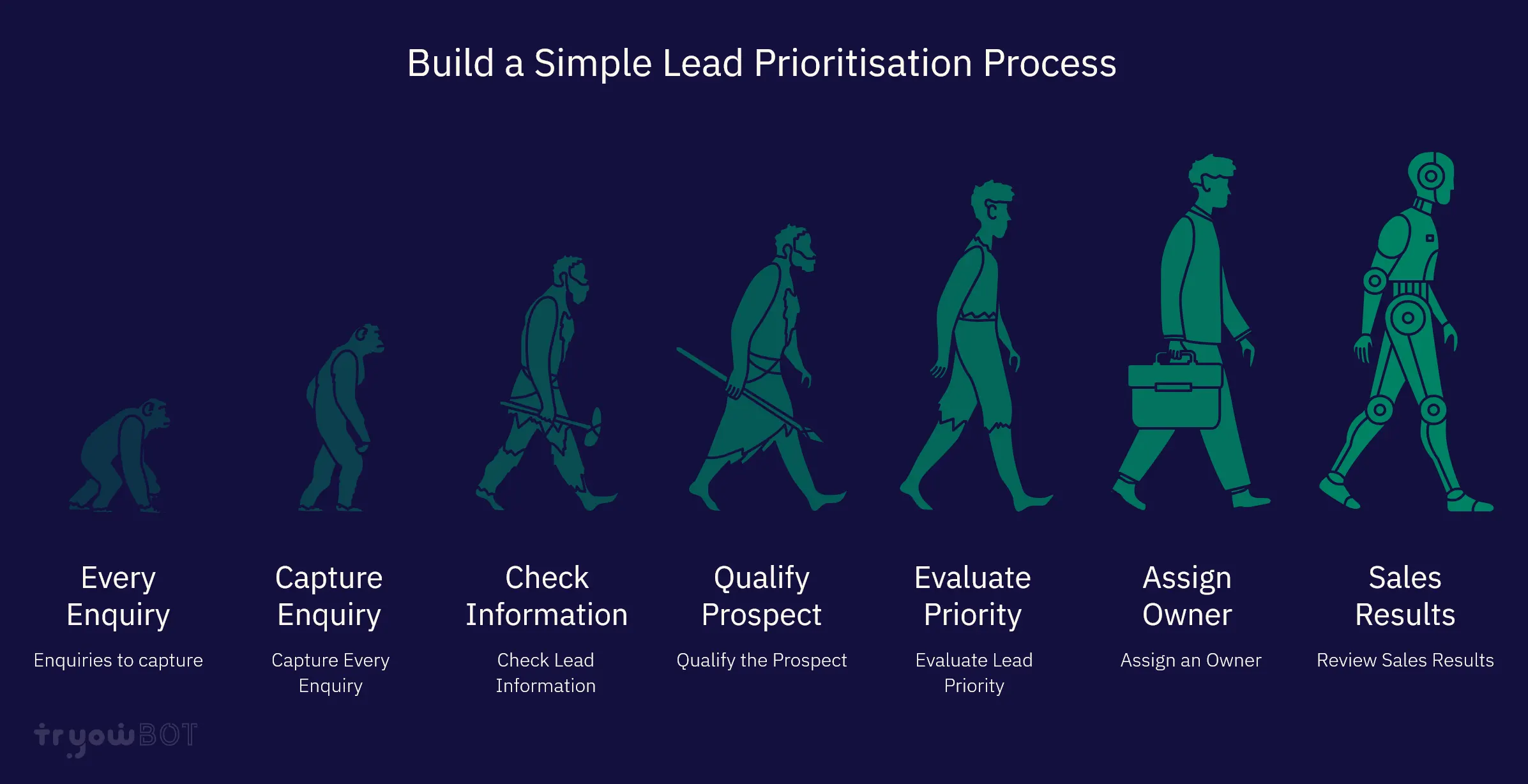
How to Build a Simple Lead Prioritisation Process for Your Business
You do not need a complicated sales strategy to start improving lead quality.
Follow these seven steps to build a practical process.
Step 1: Capture Every Enquiry
Bring leads from your website, advertising campaigns, WhatsApp, email and other channels into a central CRM.
Step 2: Check Lead Information
Verify contact details, remove duplicates and record the lead source, requirement and other relevant information.
Step 3: Qualify the Prospect
Understand the customer's need, budget, decision-making authority and purchase timeline.
Step 4: Evaluate Lead Priority
Use buying signals, customer fit, engagement and lead scoring to identify which prospects need immediate attention.
Step 5: Assign an Owner
Make sure every lead has a responsible salesperson.
Step 6: Schedule the Next Action
Create a follow-up task with a clear date, time and purpose.
Step 7: Review Sales Results
Monitor qualified leads, deal creation, successful sales and lost opportunities. Use these results to improve your qualification process.
When this process is followed consistently, businesses can manage enquiries more effectively and reduce the chances of missing valuable sales opportunities.
Frequently Asked Questions
1. What is a high-quality lead?
A high-quality lead is a potential customer who has a genuine requirement, is a suitable fit for your product or service and has a reasonable possibility of making a purchase. Budget, decision-making authority, engagement and purchase timeline can help determine lead quality.
2. How do I identify high-quality leads?
Evaluate customer requirements, budget, decision-making authority, purchase timeline, engagement and customer fit. Using a consistent qualification framework helps sales teams identify prospects who are more likely to become customers.
3. What is the difference between lead qualification and lead scoring?
Lead qualification is the process of determining whether a prospect is a suitable sales opportunity. Lead scoring assigns a score to help evaluate and prioritise prospects based on selected signals or criteria.
Qualification helps determine suitability, while scoring helps organise priority.
4. What is a hot lead?
A hot lead is a prospect showing strong buying intent or sales readiness. For example, a customer who has a clear requirement, confirmed budget and immediate purchase timeline may be considered a hot lead.
However, businesses should use their own qualification criteria rather than relying on a label alone.
5. How should sales teams prioritise leads?
Sales teams should consider buying intent, customer fit, deal value, purchase timeline, lead score and follow-up urgency. High-priority prospects should receive timely attention, while long-term prospects can be managed through planned nurturing activities.
6. Can CRM software automatically identify high-quality leads?
Some CRM systems provide lead scoring, AI-generated suggestions, segmentation and sales activity tracking to help identify potential high-quality leads. However, these features depend on the available data and configuration. Human review remains important.
7. Why is lead follow-up important?
Follow-up helps maintain communication, answer customer questions and move opportunities towards a purchasing decision. Delayed or forgotten follow-ups can cause businesses to lose otherwise valuable prospects.
8. How does TryowBOT CRM help prioritise sales opportunities?
TryowBOT CRM provides lead scoring with suggestions, lead status tracking, lead segmentation, assignment rules, task priorities, follow-up management and sales reports. These features help businesses organise enquiries and focus on important sales opportunities.
9. Should businesses reject low-scoring leads?
Not necessarily. A low score may indicate limited information or engagement rather than a complete lack of interest. Businesses should consider the customer's circumstances, follow-up history and potential future requirements before deciding whether to continue nurturing or close the lead.
10. What metrics should businesses track to measure lead quality?
Useful metrics include qualified leads, lead-to-deal conversion rate, lead-to-customer conversion rate, cost per qualified lead, deal win rate, revenue by lead source and average time to first contact.
Conclusion
Not every enquiry is a sales opportunity, and not every sales opportunity deserves the same level of attention.
Businesses that focus only on generating more leads may overlook the importance of identifying suitable prospects and following up at the right time.
By evaluating customer requirements, budget, decision-making authority, purchase timeline, engagement and customer fit, sales teams can make better decisions about which opportunities to prioritise.
A well-organised CRM process makes this easier by bringing lead information, scoring, segmentation, assignment, follow-ups and sales reporting together.
TryowBOT CRM helps businesses manage the entire journey from incoming enquiry to qualified sales opportunity, giving sales teams a clearer way to organise their work and managers better visibility into the sales pipeline.
Stop treating every enquiry equally. Focus on the opportunities that can move your business forward.
Explore TryowBOT CRM and build a smarter lead management process for your business.